
Does Shockwave Therapy for Plantar Fasciitis Help?
That sharp, bruised feeling under the heel can make the first few steps of the morning feel far bigger than they should. When stretching, rest, supportive shoes, and activity changes have not brought enough relief, shockwave therapy plantar fasciitis treatment may be worth discussing with a qualified clinician. It is not a quick fix for every case, but it can be a useful option for stubborn heel pain when it is part of a personalized recovery plan.
What plantar fasciitis really involves
The plantar fascia is a strong band of connective tissue that runs along the bottom of the foot, from the heel toward the toes. It helps support the arch and manages force every time you walk, run, jump, or stand for long periods. Plantar fasciitis describes pain and irritation involving this tissue, most commonly near where it attaches to the heel.
The classic pattern is pain with the first steps after getting out of bed or standing after a long period of sitting. It may ease as you move, then return after a long walk, a run, a work shift, or a busy day on your feet. Some people feel a pinpoint ache at the bottom of the heel; others describe a pulling sensation through the arch.
This problem is not limited to runners. It can affect active adults increasing their training volume, workers who stand for much of the day, and people whose footwear or foot mechanics are no longer supporting them well. Tight calves, limited ankle mobility, a recent jump in activity, reduced foot strength, and training on hard surfaces can all contribute. Sometimes there is no single cause. That is why a proper assessment matters before choosing treatment.
How shockwave therapy for plantar fasciitis works
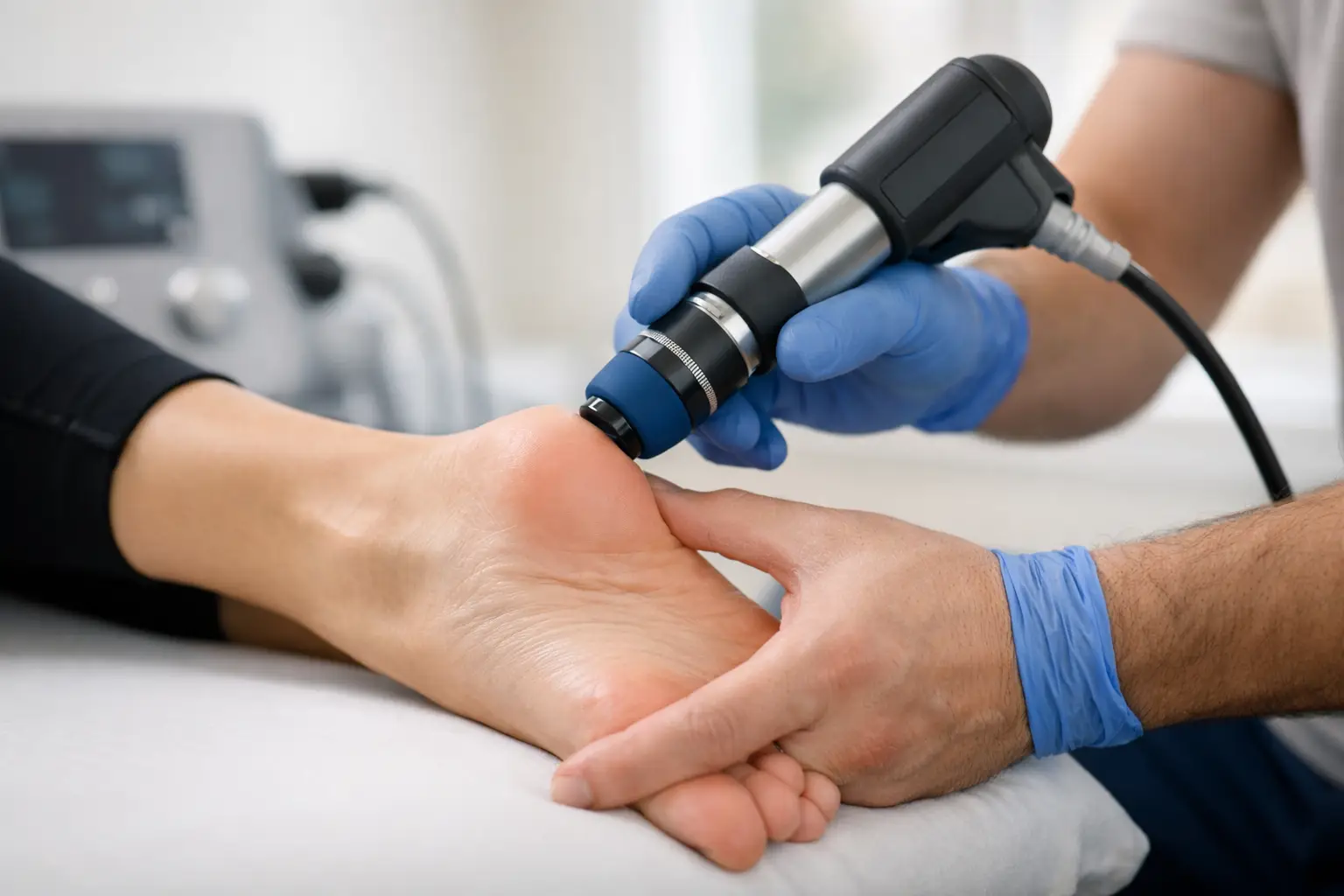
Shockwave therapy, often called extracorporeal shockwave therapy, uses controlled acoustic pressure waves delivered through a handheld device. During treatment, the clinician applies gel to the area and moves the applicator over the painful heel and surrounding tissue.
The goal is not to numb the pain. The mechanical stimulus is intended to support the body’s healing response in tissue that has become slow to recover. It may help improve local circulation, influence pain signaling, and encourage the tissue remodeling process. For plantar heel pain that has persisted despite initial conservative care, clinical research supports shockwave therapy as a non-surgical treatment option that may reduce pain and improve function for many patients.
Results vary. The duration of symptoms, the accuracy of the diagnosis, your activity demands, footwear, and the presence of calf or foot weakness all affect the outcome. Shockwave is generally most useful when it is paired with the work that addresses why the plantar fascia became overloaded in the first place.
Radial and focused shockwave treatment
Clinics may use radial or focused shockwave devices. Both deliver acoustic energy, but the energy pattern and depth differ. One is not automatically better for every person. Your clinician can recommend an approach based on the location of your symptoms, tissue sensitivity, medical history, and assessment findings.
The most important factor is not simply receiving a machine-based treatment. It is having a clinician identify whether plantar fascia irritation is truly driving your pain and integrate shockwave therapy appropriately into your plan.
What a session feels like
A shockwave session is usually brief. You may feel a tapping or pulsing sensation over the heel, and the area can be tender during treatment. The intensity should be adjusted to a level you can tolerate. Communication matters: you should tell your clinician if the sensation feels too intense or sharply painful.
Some people notice mild soreness, redness, or sensitivity in the area afterward. This typically settles within a short period. Your therapist may advise you to avoid high-impact exercise immediately after a session, particularly if the heel has been significantly irritated. That does not necessarily mean complete rest. In many cases, controlled movement and a gradual return to activity are part of the plan.
A course of care commonly involves multiple sessions spaced over several weeks, though the recommended number depends on your presentation and response. Improvement is often gradual rather than immediate. Some patients begin to notice changes within a few weeks, while others need more time to build tolerance and see meaningful day-to-day improvement.
When it may be a good fit
Shockwave therapy may be considered when heel pain has lasted for several months, continues to limit walking, work, exercise, or sport, and has not improved enough with first-line strategies. Those strategies often include activity modification, mobility work, strengthening, footwear guidance, and support for the foot where appropriate.
It can be especially helpful for the person who has stopped running because every landing hurts, the teacher who dreads the final hours of a standing shift, or the active parent who is avoiding walks with the family. The target is not only lower pain on a pain scale. It is restoring confidence in daily movement.
However, heel pain is not always plantar fasciitis. A stress injury, nerve irritation, fat pad pain, Achilles-related symptoms, inflammatory conditions, or pain referred from elsewhere can sometimes feel similar. Treating the wrong problem delays recovery, even with an effective modality. An assessment should look at your symptoms, walking pattern, ankle motion, calf capacity, foot strength, footwear, and training or workload history.
Shockwave therapy may not be appropriate for everyone. Certain medical conditions, medications, pregnancy considerations, circulation concerns, or treatment over particular areas may require an alternative approach. Your clinician should review your health history and explain any precautions before proceeding.
Why exercise and load management still matter
It is tempting to hope that one treatment will solve heel pain. Yet plantar fasciitis usually develops because the tissue has been asked to handle more load than it can currently tolerate. If that mismatch remains unchanged, symptoms can return.
A well-designed plan often includes calf and plantar fascia mobility, progressive strengthening for the calf and foot, and guidance on how to adjust aggravating activities without losing all momentum. For a runner, that might mean temporarily reducing hill work, speed sessions, or total mileage while building capacity. For someone who stands at work, it may involve footwear changes, planned movement breaks, and strategies to reduce prolonged stress on the heel.
Orthotics, supportive shoes, taping, manual therapy, or other rehabilitation treatments may also have a place, depending on the assessment. They should be selected because they solve a specific problem, not because they are routinely handed to everyone with heel pain. A temporary support can reduce irritation while strength and tolerance are rebuilt, but support alone does not replace rehabilitation.
At Momentum Therapy, care can combine shockwave therapy with one-on-one rehabilitation planning, so the focus stays on both symptom relief and the movement goals that matter to you.
Practical questions to ask before treatment
Before beginning, ask what the clinician believes is causing your pain and what findings support that conclusion. Ask how shockwave fits alongside exercise, what activities you should modify, and how progress will be measured. Clear answers help you understand whether treatment is moving you toward walking comfortably, returning to the gym, completing a shift without limping, or getting back to sport.
It is also reasonable to ask what a realistic timeline looks like. Persistent plantar heel pain can improve, but recovery is rarely perfectly linear. A flare after an unusually busy weekend does not automatically mean treatment has failed. The larger trend matters: less pain with first steps, greater walking tolerance, better calf strength, and more confidence loading the foot.
Give your heel a plan, not just a treatment
Shockwave therapy can be a valuable tool for plantar fasciitis, particularly when pain has lingered and progress has stalled. Its value grows when it is used alongside an accurate diagnosis, progressive rehabilitation, and practical changes that fit your work, family life, and activity goals.
You do not need to accept heel pain as the cost of staying active. With a thoughtful assessment and a plan that respects both your symptoms and your goals, each step can begin to feel more manageable again.